Our all-in-one sustainable marketing simulation has students running the full marketing mix while balancing profit, people and planet in a shifting market. It's experiential learning that fits any course, and ends with job-ready skills.
Students take over as the management team of a jetpack manufacturer under real pressure to prioritize ESG.
Sustainable strategy
Balance profit, people and planet
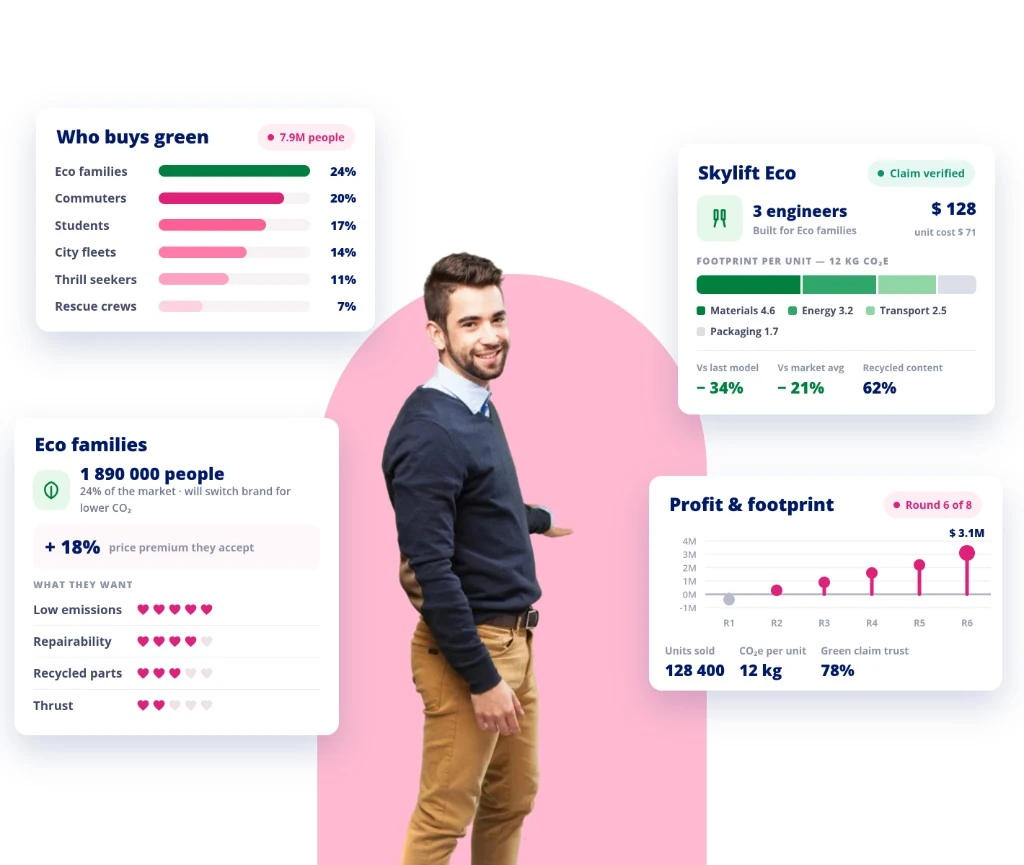
Students make the calls sustainable marketers actually face — invest in new product lines or eco-friendly upgrades, cut costs or cut emissions — and see every trade-off land in both sales and ESG metrics.
Weigh emissions cuts against margins round by round.
Turn sustainability from a cost into a competitive advantage.
ESG in the marketing mix
Run the marketing mix with ESG built in
Sustainability is more than a product feature: Students position against shifting consumer preferences, absorb carbon taxation and rising industry standards and decide how transparent their company should be.
Adapt positioning as consumer preferences shift toward sustainability.
Respond to carbon taxes, ESG standards and reporting demands.
Plus four more skills they build along the way
Double materiality analysis
Map what the company impacts and what impacts the company, then let it drive the market plan.
Social responsibility
From DEI initiatives to workplace scandals, navigate stakeholder situations that hit performance.
Market planning
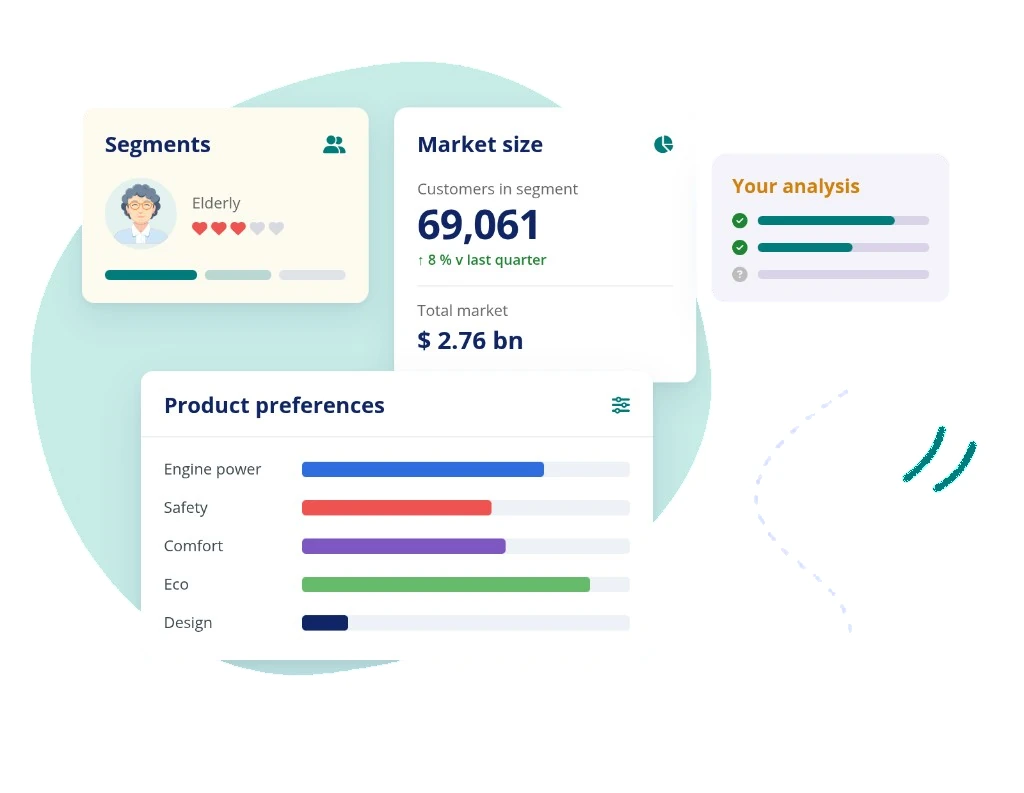
Assess the market, select segments and position — practice the core of marketing with sustainability woven in.
Financial sustainability
Make green decisions add up by managing profit, cash flow and market position.
Sustainability made easy
Making sustainability part of marketing education
Adding sustainability to a marketing course usually means new readings, new cases and a rebuilt syllabus. This simulation does it in one move: The same marketing core you already teach — segmentation, positioning, the marketing mix — now plays out in a market where ESG shapes demand, costs and reputation. Drop it into the course you already run; the sustainability teaching comes built in.
Market plan, double materiality analysis, competitor analysis and reflection — with AI-graded feedback.
Decision events
Carbon offsetting, ESG reporting and DEI initiatives arrive as choices with consequences, not lecture slides.
Market events
Carbon taxation, rising industry ESG standards and shifting consumer preferences keep every strategy honest.
This is, hands down, the best way to introduce sustainability into marketing education.
Tarje Gaustad
Associate Professor of Marketing, BI Norwegian Business School
94%of educators and students recommend Hubro
90%choose to run our simulations again next term
80%of students report stronger engagement and understanding
500+institutions use Hubro worldwide
Inside the simulation
Decisions just like real sustainable marketers make on the job
Every round mirrors the calls real marketing teams make under ESG pressure — what to build, where to position, when to cut emissions and how to report it — while carbon taxes, industry standards and consumer preferences keep moving.
Designed for educators
Less prep means more time for teaching
Between planning, lecturing and grading, every minute counts. Hubro's Sustainable Marketing simulation is quick to set up and easy to use with customization options to meet your course needs.
Easy-to-use platform
Premade assignments and instructor materials make it ready to launch on day one.
Ready-made assessments
Built-in tools and reflection exercises speed up the grading process. See simulation assessment.
Customizable schedule
Content and rounds that can be added or removed to fit your syllabus, not the other way around.
AI assistance
AI grading, support and debriefing so you can save time and run the simulation to perfection.
Dedicated support team
Real education specialists available to help from start to finish. See Hubro support.
LMS integration
Compatible with Canvas, Moodle, Blackboard and Brightspace for assignment delivery and grade syncing. LMS integration.
Real-time data
See how every group is doing, where they're stuck and when to step in.
LinkedIn certificates
Certificates that can be posted on LinkedIn to demonstrate skills and show career readiness.
Balanced Scorecard
Measure what matters the most
Customize the Balanced Scorecard around your learning objectives, weight the metrics that matter and see group rankings update instantly. Simulation assessment.
One simulation for a wide range of marketing courses
Its home ground is the introductory marketing course — and it travels anywhere sustainability needs to enter the syllabus, from marketing ethics modules to corporate programs. One simulation, adapted to your course.
Sustainable marketingPrinciples of marketingIntroduction to marketingMarketing ethicsCSR and ESGSustainability in businessMarketing managementExecutive educationCorporate L&D
What educators are saying
Created with the experts who teach sustainable marketing
This is, hands down, the best way to introduce sustainability into marketing education.
Tarje Gaustad
Associate Professor of Marketing, BI Norwegian Business School
Students were thinking like marketers, outside of class. They were applying 4P concepts in the formulation of marketing strategy, just like we did every day in the business world.
Scott Griffith
Assistant Professor of Business Administration - Marketing, Briar Cliff University
Sustainable marketing simulation comparison
One simulation that does what general sustainability sims can't
Sustainability teaching tools tend to come in two shapes: sustainability business simulations that run general management with ESG dials or single-topic exercises that make their point and stop. The Hubro Sustainable Marketing simulation is built on a marketing core: The mix plays out in a market where ESG moves demand, costs and reputation, ready to drop into the intro course you already teach.
Hubro versus established sustainability business simulations and single-topic sustainability exercises
Capability
Hubro Sustainable Marketing
Established sustainability business simulation
Single-topic sustainability exercise
Sustainability inside a marketing coreSegmentation, positioning and the mix with ESG built in
Hubro Sustainable Marketing: Included
Established sustainability business simulation: Not offered
Single-topic sustainability exercise: Not offered
Financial + ESG scoringPerformance measured on both, every round
Hubro Sustainable Marketing: Included
Established sustainability business simulation: Included
Single-topic sustainability exercise: Not offered
ESG decision eventsCarbon offsetting, ESG reporting and DEI initiatives
Hubro Sustainable Marketing: Included
Established sustainability business simulation: Limited / varies