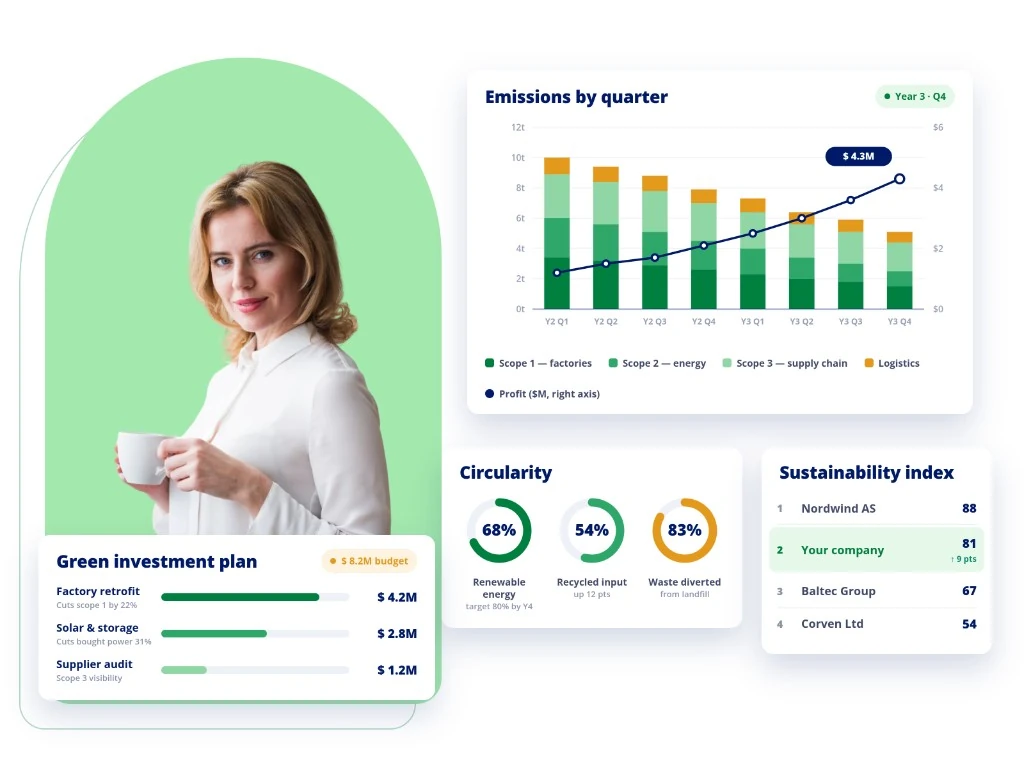
Our all-in-one sustainable business simulation has students running a company where the ESG index determines who they can sell to, prices their loans and rewards every sustainable choice. It's experiential learning that fits any course, and ends with job-ready skills.
Students take over as the management team of one of five newly started jetpack manufacturers, in an industry the world expects to be sustainable.
Sustainable strategy
Balance profit, people and planet
Students run a company where success is scored on equity and the ESG index together, and neglecting their index has big consequences for their business.
Grow equity by being profitable.
Keep the ESG index above the bar the market demands.
ESG in operations
Run operations with ESG built in
Sustainability is a part of all major decisions. Students choose between cheap and sustainable suppliers, invest in emissions-reduction projects and manage production while every call moves both the financials and ESG index.
Pick suppliers with the ESG consequences priced in.
Invest in emissions reductions that pay back in market access.
Plus four more skills they build along the way
Investment and production
Build factories, set volumes and live with the capacity — and the emissions — you created.
Budgeting and financing
Manage budgets and loans from a bank that prices your ESG index into the interest rate.
Ethical decisions
Face scenarios where what's right and what's profitable may not always align, and answer for the choice.
Financial sustainability
Equity only grows when the company earns it; green choices still have to add up.
Sustainability made easy
Making sustainability part of business education
Sustainability impacts every business discipline. Adding it to a course usually means new readings, new cases and a rebuilt syllabus. This simulation does it in one move: The same business core you already teach — strategy, production, budgeting, finance — now plays out in a market where ESG decides who buys, what borrowing costs and which strategies survive. Drop it into the course you already run; the sustainability teaching comes built in.
The index determines market access and prices loans, so sustainability is strategy, not a side quest.
Ethical decision events
Built-in scenarios where right and profitable may diverge, ready to debrief in class.
Carbon tax, optional
Educators can switch market events like carbon taxation on or off to match the course.
The impact of climate change is rapidly becoming more visible and tangible worldwide. We are also seeing its effects more and more clearly in the economy as climate risks translate into financial losses. (..) I hope it is obvious why sustainability is key in business education and in business simulations.
Coen van Hout
Academy Manager / Lecturer, Finance and Economics, HAN University of Applied Sciences
94%of educators and students recommend Hubro
90%choose to run our simulations again next term
80%of students report stronger engagement and understanding
500+institutions use Hubro worldwide
Inside the simulation
Sustainability decisions just like real managers make on the job
Every quarter mirrors the calls real management teams make under ESG pressure — what to build, who to buy from, what to borrow and when to invest in emissions cuts — while written exercises, market events and ethical decisions keep the plans honest.
Step 1 · ResearchDevelop new technology
Waste reductionDeveloped
Lightweight chassis$ 160,000
Substitute parts$ 240,000
Step 2 · FinancingFund the plan
Long-term loanAlready at 7 %
Retained profitNo interest
$ 0Raised this quarter
Step 3 · ProductionManage production
Factories
Zander
Bert
Jovan
Ila
Serena
Activity level145 %
0100 %200 %
1,880Units built$ 213 a unit
Step 4 · MarketingCompete for contracts
Marketing spend$ 30,000
Who chooses contracts first
Your company$ 30,000First pick
Emil Corp$ 24,000
Burkina Corp$ 11,000
Step 5 · ReportAnalyze reported results
Q2 2102 closed
$ 118kProfit this quarter
$ 472kRevenue delivered
$ 690kCompany value
# 2 of 5Ranking
#1
You
#3
#4
#5
Designed for educators
Less prep means more time for teaching
Between planning, lecturing and grading, every minute counts. Hubro's Sustainable Business simulation is quick to set up and easy to use with customization options to meet your course needs.
Easy-to-use platform
Premade assignments and instructor materials make it ready to launch on day one.
Ready-made assessments
Built-in tools and reflection exercises speed up the grading process. See simulation assessment.
Customizable schedule
Content and rounds that can be added or removed to fit your syllabus, not the other way around.
AI assistance
AI grading, support and debriefing so you can save time and run the simulation to perfection.
Dedicated support team
Real education specialists available to help from start to finish. See Hubro support.
LMS integration
Compatible with Canvas, Moodle, Blackboard and Brightspace for assignment delivery and grade syncing. LMS integration.
Real-time data
See how every group is doing, where they're stuck and when to step in.
LinkedIn certificates
Certificates that can be posted on LinkedIn to demonstrate skills and show career readiness.
Balanced Scorecard
Measure what matters the most
Customize the Balanced Scorecard around your learning objectives, weight the metrics that matter and see group rankings update instantly. Simulation assessment.
One simulation for a wide range of business courses
From core introduction to business and management accounting courses to specialized sustainable business programs, the Hubro Sustainable Business simulation fits into any business syllabus. One simulation, adapted to your course.
Sustainable businessIntroduction to businessManagement accountingBusiness ethicsCSR and ESGBusiness and societyBusiness strategyExecutive educationCorporate L&D
What educators are saying
Trusted by educators who teach sustainable business
The impact of climate change is rapidly becoming more visible and tangible worldwide. We are also seeing its effects more and more clearly in the economy as climate risks translate into financial losses. (..) I hope it is obvious why sustainability is key in business education and in business simulations.
Coen van Hout
Academy Manager / Lecturer, Finance and Economics, HAN University of Applied Sciences
If you want your students to be able to apply theories in their future jobs, Hubro is the one, I found so far, to make a virtual business environment that is quite close to the real world.
Sandra Zhu-Bandelier
Business Lecturer, Cesar Ritz Colleges, Switzerland