










Check out our new Digital Marketing simulation
Sustainable Finance simulation

Teach sustainable finance for the real world

Our all-in-one sustainable finance simulation has students funding investments, paying dividends and managing ESG — with a stock price that scores sustainability and financials together. It's experiential learning that fits any course — and ends with job-ready skills.

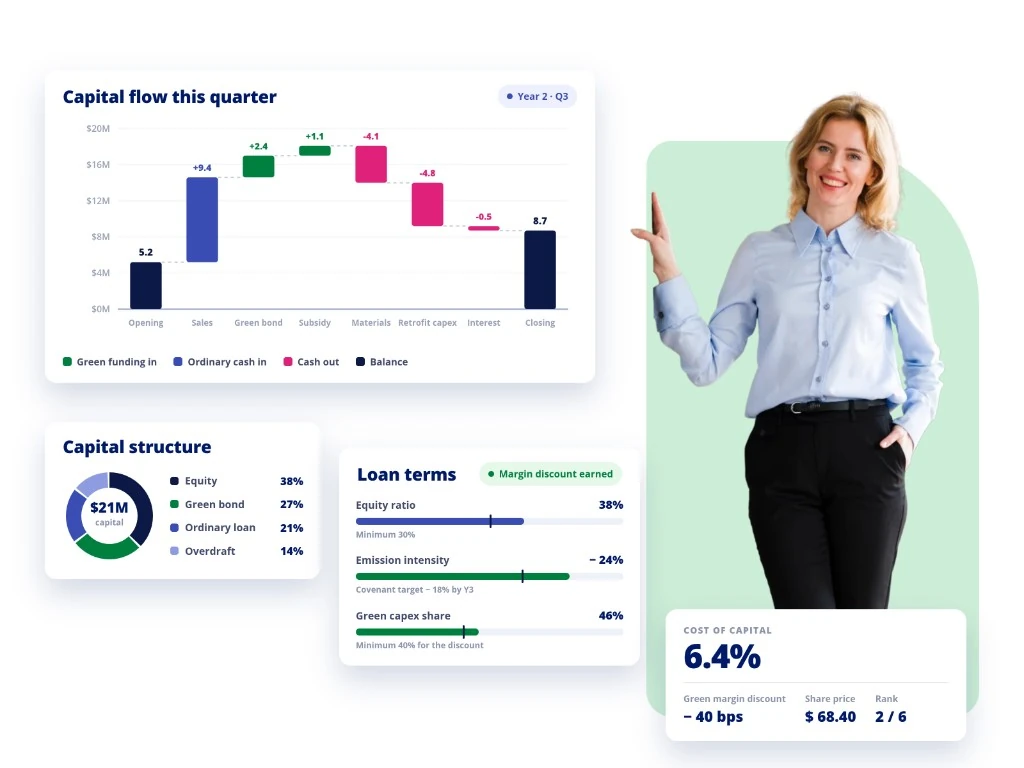
Hubro Sustainable Finance simulation — capital flow, capital structure, loan terms and cost of capital
  • 4–12 hours
  • 1–3 per group (up to 4)
  • Unlimited class size
  • B2B · manufacturing
  • Stock price scores ESG
  • Carbon tax optional
  • Fits multiple courses
  • LMS-ready · Canvas, Blackboard, Moodle, Brightspace
What students learn

One simulation for all of sustainable finance

Students take over as the management team of a newly started jetpack manufacturer — in an industry the world expects to be sustainable. They'll build skills as they fund the company, weigh investments, pay dividends and answer to a stock price that prices ESG in.

Sustainable value creation

Grow a stock price that prices ESG in

Success here is measured on the stock price — and how the company performs on ESG is factored directly into it. Students learn how firms create value for shareholders and society, and what happens to valuation when they trade one off against the other.

  • Watch ESG performance move the market's valuation, quarter by quarter.
  • Balance shareholder value against social and environmental responsibility.

Financing sustainable growth

Fund growth the sustainable way

Students issue shares and bonds, choose growth and funding strategies and set dividends — in a market where the ESG index also shapes the interest rate the company pays.

  • Issue shares and bonds as funding needs grow.
  • Set dividend strategy and watch the market respond.

Plus four more skills they build along the way

Valuation and metrics

Use financial analysis and metrics the way managers do — and see decisions land in profitability, cash flow and valuation.

Carbon tax and incentives

Work with sustainability incentives and disincentives like carbon taxation — switched on or off by the educator.

Ethical decisions

Face built-in scenarios where what's right and what's profitable pull apart — and answer for the choice.

Budgeting and cash flow

Manage budgets and liquidity so the company can meet its commitments while funding sustainable growth.

Sustainability made easy

Making sustainability part of finance education

Sustainability is not a siloed discipline — it impacts every finance decision. Adding it to a course usually means new readings, new cases and a rebuilt syllabus. This simulation does it in one move: the same finance core you already teach — funding, valuation, dividends, cash flow — now plays out in a market where ESG moves the stock price, investor valuation and the cost of debt. Drop it into the course you already run; the sustainability teaching comes built in.

The market prices ESG

Sustainability performance flows straight into the stock price, so the lesson teaches itself.

Ethical decision events

Built-in dilemmas with financial consequences, ready to debrief in class.

Carbon tax, optional

Educators switch incentives and disincentives on or off to match the course.

The impact of climate change is rapidly becoming more visible and tangible worldwide. We are also seeing its effects more and more clearly in the economy as climate risks translate into financial losses. (..) I hope it is obvious why sustainability is key in business education and in business simulations.

Coen van Hout
Coen van Hout Academy Manager / Lecturer, Finance and Economics, HAN University of Applied Sciences
94% of educators and students recommend Hubro
90% choose to run our simulations again next term
80% of students report stronger engagement and understanding
500+ institutions use Hubro worldwide
Designed for educators

Less prep means more time for teaching

Between planning, lecturing and grading, every minute counts. Hubro's Sustainable Finance simulation is quick to set up and easy to use with customization options to meet your course needs.

Easy-to-use platform

Premade assignments and instructor materials make it ready to launch on day one.

Ready-made assessments

Built-in tools and reflection exercises speed up the grading process.

Customizable schedule

Content and rounds that can be added or removed to fit your syllabus, not the other way around.

AI assistance

AI grading, support and debriefing so you can save time and run the simulation to perfection.

Dedicated support team

Real education specialists available to help from start to finish.

LMS integration

Compatible with Canvas, Moodle, Blackboard and Brightspace for assignment delivery and grade syncing.

Real-time data

See how every group is doing, where they're stuck and when to step in.

LinkedIn certificates

Certificates that can be posted on LinkedIn to demonstrate skills and show career readiness.

Balanced Scorecard

Measure what matters the most

Customize the Balanced Scorecard around your learning objectives, weight the metrics that matter and see group rankings update instantly.

  • Adjust metric weights to fit your course goals.
  • Export simulation results when the round closes.
Balanced Scorecard
Learner
World
Filter by name

Learner Stock PriceESG PerformanceNet Profit Weighted Score
SL Sofia L
91.30%
87.45%
75.06%
84.60%
DK Daniel K
62.84%
39.17%
59.12%
53.71%
NR Nora R
38.62%
24.80%
29.73%
31.05%
Where it fits

One simulation for a wide range of finance courses

Its home ground is the courses the live page already names — corporate finance, introduction to finance and specialized sustainable finance — and it travels anywhere sustainability needs to enter the finance syllabus. One simulation, adapted to your course.

Sustainable finance Corporate finance Introduction to finance Financial management CSR and ESG Sustainability in business MBA finance Executive education Corporate L&D
What educators are saying

Trusted by educators who teach sustainable finance

The impact of climate change is rapidly becoming more visible and tangible worldwide. We are also seeing its effects more and more clearly in the economy as climate risks translate into financial losses. (..) I hope it is obvious why sustainability is key in business education and in business simulations.
The simulation enables students to get hands-on experience in the finance decisions businesses make. I highly recommend it.
Show questions about

A sustainable finance simulation is an interactive learning tool where students manage a company's finances in a market that prices sustainability — funding investments, setting dividends and managing ESG while the stock price scores it all, without real-world risk. In Hubro's Sustainable Finance simulation, ESG performance flows into the stock price, investor valuation, customer access and the interest rate on debt.

In many sustainability tools, ESG is a score on a dashboard. In Hubro Sustainable Finance the market prices it: ESG performance is factored directly into the stock price, shapes the interest rate on debt and decides which customers a company can reach. Students issue shares and bonds, set dividend strategy and face ethical decision events — all in a simulation that drops into an existing finance course.

Both run companies where sustainability shapes outcomes. Hubro Sustainable Finance keeps the finance curriculum at the center — students practice funding, valuation and dividend strategy while the stock price prices ESG in — so for a corporate finance or introduction-to-finance course that needs sustainability built in, it's the closer fit than a general management exercise.

Students learn how companies balance financial and environmental sustainability, how they create value for shareholders and society, how decisions impact profitability, cash flow and valuation, how growth and funding strategies work and how incentives like carbon taxation change the calculus — with financial analysis and metrics guiding every call.

The research supports simulation-based learning for applied skills — peer-reviewed studies have found significant test-score and critical-thinking gains when simulations supplement a course, including in finance teaching specifically. Sustainability especially benefits: it's a subject of trade-offs, and a stock price that weighs an emissions cut against a dividend teaches the tension better than a lecture slide can.

They share the same sustainable jetpack universe but train different muscles. Sustainable Finance is built on Hubro Finance: funding, valuation and dividends, with success measured on a stock price that prices ESG in — at home in corporate finance and introduction-to-finance courses. Sustainable Business is built on Hubro Business: strategy, production, suppliers and budgeting, with success scored on equity and the ESG index — at home in introduction-to-business and management accounting courses. See the Sustainable Business simulation.

Yes. Sustainable finance is one of the fastest-growing corners of the profession, and students here practice it — weighing emissions investments against dividends, funding growth under ESG-priced debt and defending choices when right and profitable pull apart. Upon completion, students can earn an optional certificate to add to their LinkedIn profile.

The simulation is flexible. It runs over eight quarterly rounds and typically takes four to twelve hours in total — from an intensive bootcamp to a multi-week integration across the course. Educators control the schedule and the number of written assignments throughout.

Both. Teams of one to three are recommended and up to four is possible, and each market holds up to five competing companies — larger classes run several markets in parallel, so there's no cap on participants.

Yes. Hubro integrates with Canvas, Moodle, Blackboard and Brightspace. This allows for seamless assignment delivery and grade syncing within your existing course infrastructure.

Hubro includes ready-made assessment tools, written exercises and reflection assignments. Educators get real-time dashboards showing each team's decisions, financials and ESG performance, and optional certificates let students showcase completion on LinkedIn.

The simulation is browser-based and requires only an internet connection. Most educators are up and running within minutes: premade assignments, an instructor manual, learner guides and an introductory video are included, and a dedicated support team helps with onboarding from start to finish.

Yes. Educators customize Hubro Sustainable Finance with their own content, activities and configurations, switch incentives like carbon taxation on or off and scale rounds and assignments up or down. The simulation is designed to fit your course — not the other way around.

This is exactly what the simulation is for. It carries the finance core you already teach — funding, valuation, dividends, cash flow — inside a market where ESG moves the stock price, investor valuation and the cost of debt, with written exercises and ethical decision events included. Carbon taxation and other incentives are optional, so you control how far sustainability reaches. There's no syllabus rebuild: drop it into the course you already run.

Yes. Hubro Sustainable Finance is used across undergraduate, graduate and MBA levels — in finance and business courses as well as specialized sustainable finance modules. Educators scale the difficulty through rounds, events and assignments.

The simulation is used in corporate finance, introduction-to-finance and specialized sustainable finance courses as well as financial management and CSR and ESG teaching. It also works in MBA finance modules, executive education and corporate training programs.

Yes of course — the simulation is designed to fit your course, not the other way around.

The simulation is designed to work on desktop and tablet screen sizes.

The simulation can be used on Google Chrome, Firefox and Safari — no installation required, just an internet connection.

Yes! Contact us for a free trial.