










Check out our new Digital Marketing simulation
Managerial Accounting simulation

Teach managerial accounting for the real world

Our all-in-one managerial accounting simulation is built on our proven Business case — and carries the accounting course on top. Students set up budgets, run the quarter and analyze the variances their own decisions created. It's experiential learning that fits any course — and ends with job-ready skills.

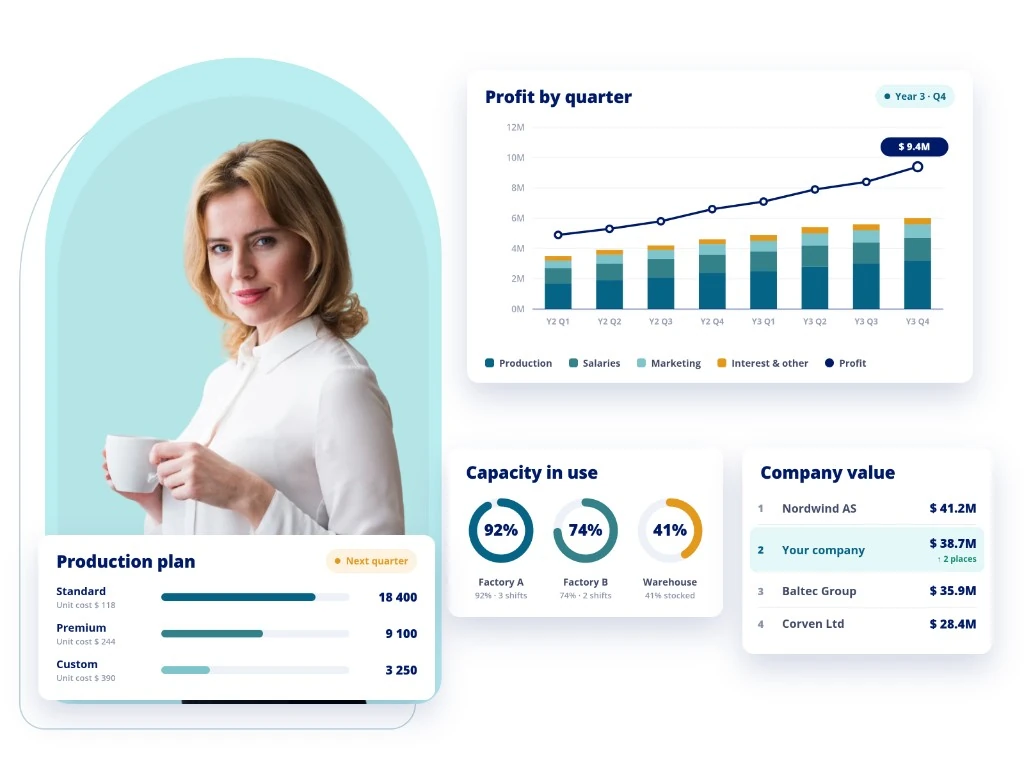
Hubro Business simulation — production plan, profit by quarter, factory capacity and company value
  • 4–12 hours
  • 2–4 per group (up to 6)
  • Unlimited class size
  • B2B · manufacturing
  • Built on the Hubro Business case
  • Budgeting & variance analysis built in
  • Balanced Scorecard assessment
  • LMS-ready · Canvas, Blackboard, Moodle, Brightspace
What students learn

One simulation for all of managerial accounting

Students take over as the management team of a jetpack manufacturer — the same proven case thousands of students have run in Hubro Business — now with the accounting course on top. They'll build skills as they budget, produce, compete and answer for every variance between the plan and what actually happened.

Budgeting

Build budgets managers actually use

Budgeting here is manual and it's the point: students set up their own budgets each quarter and learn how strategy, goals and plans must show up in the numbers — because next quarter, the market grades the plan.

  • Set up quarterly budgets by hand with the simulation's manual budgeting functionality.
  • Make the budget carry the strategy — and defend it in the board room role play.
Variance analysis

Analyze variances they caused themselves

After each quarter, students compare the budget to the actuals — and every variance has an author. A missed contract, an overbuilt factory, a market event: the analysis means something because the numbers are theirs.

  • Run budget-versus-actuals after every quarter.
  • Trace each variance to the decision or event that caused it.

Plus four more skills they build along the way

Financial statements

Read and act on statements the company itself produced, quarter after quarter.

KPIs and performance measurement

Measure company performance on KPIs — and assess it with the built-in Balanced Scorecard.

Product calculations and mix

Set the product mix with real product calculations — demand, costs and strategy in one call.

Ethics and sustainability decisions

Face special decisions related to ethics and sustainability — where the numbers and the right answer can pull apart.

Many students never get a proper understanding of how operations and financial statements fit together. I think Hubro Business makes these connections practical and completely clear to them.

Bo Karlsson
Bo Karlsson Professor, Industrial Management, KTH Royal Institute of Technology
94% of educators and students recommend Hubro
90% choose to run our simulations again next term
80% of students report stronger engagement and understanding
500+ institutions use Hubro worldwide
Designed for educators

Less prep means more time for teaching

Between planning, lecturing and grading, every minute counts. Hubro's Managerial Accounting simulation is quick to set up and easy to use with customization options to meet your course needs.

Easy-to-use platform

Premade assignments and instructor materials make it ready to launch on day one.

Ready-made assessments

Built-in tools and reflection exercises speed up the grading process.

Customizable schedule

Content and rounds that can be added or removed to fit your syllabus, not the other way around.

AI assistance

AI grading, support and debriefing so you can save time and run the simulation to perfection.

Dedicated support team

Real education specialists available to help from start to finish.

LMS integration

Compatible with Canvas, Moodle, Blackboard and Brightspace for assignment delivery and grade syncing.

Real-time data

See how every group is doing, where they're stuck and when to step in.

LinkedIn certificates

Certificates that can be posted on LinkedIn to demonstrate skills and show career readiness.

Balanced Scorecard

Measure what matters the most

Customize the Balanced Scorecard around your learning objectives, weight the metrics that matter and see group rankings update instantly.

  • Adjust metric weights to fit your course goals.
  • Export simulation results when the round closes.
Balanced Scorecard
Learner
World
Filter by name

Learner Total EquityNet ProfitMarket Share Weighted Score
HN Hanna N
94.18%
81.02%
63.70%
79.63%
OD Omar D
66.35%
44.87%
33.64%
48.29%
SV Sara V
38.44%
12.19%
27.61%
26.08%
Where it fits

One simulation for a wide range of accounting courses

Its home ground is the foundational management accounting course — undergraduate, graduate or MBA — and it travels from cost and management accounting to management control and business administration programs. Run it mid-course to apply the theory, or early as a way to learn by exploring. One simulation, adapted to your course.

Managerial accounting Management accounting Cost and management accounting Accounting for managers Management control Business administration MBA accounting modules Executive education Corporate L&D
Show questions about

A managerial accounting simulation — also called a management accounting simulation — is an interactive learning tool where students run a company and practice the accountant's craft on numbers the business itself produces: setting budgets, analyzing variances, reading financial statements and measuring performance on KPIs, all without real-world risk. In Hubro's Managerial Accounting simulation, students run a jetpack manufacturer through ten quarters and answer for every gap between the plan and the result.

Most tools in this space are homework platforms: auto-graded problem sets on static textbook data. Hubro Managerial Accounting is a live company — students set up budgets by hand with the manual budgeting functionality, run the quarter against real competitors and then analyze variances their own decisions created. The analysis means something because the numbers are theirs.

They do different jobs, and many courses use both. Homework platforms drill technique on prepared data — efficient for practice at scale. Hubro adds what a problem set can't: a company where students cause the numbers, budget the next quarter and defend the variances afterward. For the applied half of a management accounting course, the simulation is the closer fit.

Yes — and deliberately so. It runs the same proven case: a manufacturing company in the emerging jetpack market, with forecasts, R&D, production, contracts and financing. On top of that case sits the accounting course — manual budgeting every quarter, variance analysis, financial statements and KPI-based performance measurement — so students practice accounting on a business that actually works underneath.

Students gain experience with how managers use budgeting as a tool, how strategy, goals and plans must show up in a company's budgets, how business decisions impact profitability and cash flow, how to read and act on financial statements and how company performance is measured with KPIs.

The research supports simulation-based learning for applied skills — peer-reviewed studies have found significant test-score and critical-thinking gains when simulations supplement a course, and accounting educators have documented deeper learning when students work with numbers a live business produces. A variance a student caused teaches more than a variance a textbook printed.

They share the same jetpack case but train different muscles. Hubro Business is the general edition: strategy, microeconomics and managerial accounting in balance, at home in introduction-to-business courses. Managerial Accounting adds the accounting course on top — manual budgeting every quarter, variance analysis, financial statements and KPI-based assessment — at home in management accounting courses.

Yes. Budgeting, variance analysis and performance measurement are the daily work of management accountants and every manager they report to — and students here practice all three on numbers they generated themselves. Upon completion, students can earn an optional certificate to add to their LinkedIn profile.

The simulation is flexible. It runs over ten quarterly rounds and typically takes four to twelve hours in total — as a one-day bootcamp, over several sessions or spread across weeks. Educators control the schedule with deadlines, gates and free-play mode, plus the number of written assignments throughout.

Teams of two to four are recommended (up to six is possible), and each market holds up to five competing companies — larger classes run several markets in parallel, so there's no cap on participants.

Yes. Hubro integrates with Canvas, Moodle, Blackboard and Brightspace. This allows for seamless assignment delivery and grade syncing within your existing course infrastructure.

Hubro includes ready-made assessment tools, written exercises with AI-graded feedback and reflection assignments — and the built-in Balanced Scorecard lets you weight the metrics that match your learning objectives and assess teams on them. Educators get real-time dashboards showing each team's budgets, results and variances.

The simulation is browser-based and requires only an internet connection. Most educators are up and running within minutes: premade assignments, quarterly briefing presentations, an instructor manual, learner guides and an introductory video are included, and a dedicated support team helps with onboarding from start to finish.

Yes. Educators customize Hubro Managerial Accounting with their own content, activities and configurations, control pacing with deadlines, gates and free-play mode, change the success criteria and scale rounds and written exercises up or down. The simulation is designed to fit your course — not the other way around.

Yes. The simulation is built for foundational management accounting courses across undergraduate, graduate and MBA levels — educators scale the difficulty through rounds, events and written assignments.

The simulation is used in managerial accounting, management accounting and cost and management accounting courses as well as accounting-for-managers and management control teaching. It also works in business administration programs, MBA accounting modules, executive education and corporate training.

Yes of course — the simulation is designed to fit your course, not the other way around.

The simulation is designed to work on desktop and tablet screen sizes.

The simulation can be used on Google Chrome, Firefox and Safari — no installation required, just an internet connection.

Yes! Contact us for a free trial.