









How a Digital Marketing Simulation Made Wendy Gillis’s Course More Realistic


Teaching digital marketing isn’t easy. The field is quickly evolving, tools change constantly and students often struggle to connect theory with real-world marketing practice.
For Wendy Gillis, a visiting instructor of marketing at the University of North Florida the challenge was finding a way to give students practical marketing experience without overwhelming them — or herself — with too many tools and platforms.
Her solution was to integrate a digital marketing simulation into her course.
“The simulation helped quiet the noise of digital marketing. Instead of trying to manage multiple platforms like HubSpot, Google Analytics and Search Console, everything was brought together in one place. That made my course manageable, and helped students actually understand what they were doing.”
— Wendy Gillis, visiting instructor of marketing, University of North Florida

Gillis has been a marketing instructor for more than 13 years. Before transitioning into teaching, Gillis spent nearly two decades working in advertising, and those experiences shaped her approach to teaching.
“I spent many years working in advertising, including time on Madison Avenue in New York,” she explained. “Because of that experience, I know how valuable real-world application is. It’s something I try to bring into all of my courses.”
Her goal is simple: help students graduate with the skills they need to succeed in modern marketing roles.
The challenge: Teach digital marketing without overwhelming students
Digital marketing courses cover a wide range of topics, including the following:
- SEO strategy
- Social media marketing
- Digital advertising
- Campaign analytics
- Customer engagement
However, teaching these topics through lectures alone is difficult. Students may understand the concepts, but according to Gillis, they often lack opportunities to apply marketing strategies in realistic scenarios.
“Students can learn the theory from a textbook, but what they really need is the opportunity to apply what they’re learning,” she said.
Another challenge is the complexity of digital marketing tools. In professional environments, marketers often use a variety of platforms, such as these:
- Google Analytics
- HubSpot
- SEO tools
- Social media management software
Introducing too many tools in a classroom setting can quickly become overwhelming.
The solution: A digital marketing simulation
To bridge the gap between theory and practice, Gillis introduced the Hubro Digital Marketing simulation into her Social Media Marketing course. The simulation allows students to step into the role of a digital marketing manager, developing and testing their strategies in a simulated business environment.
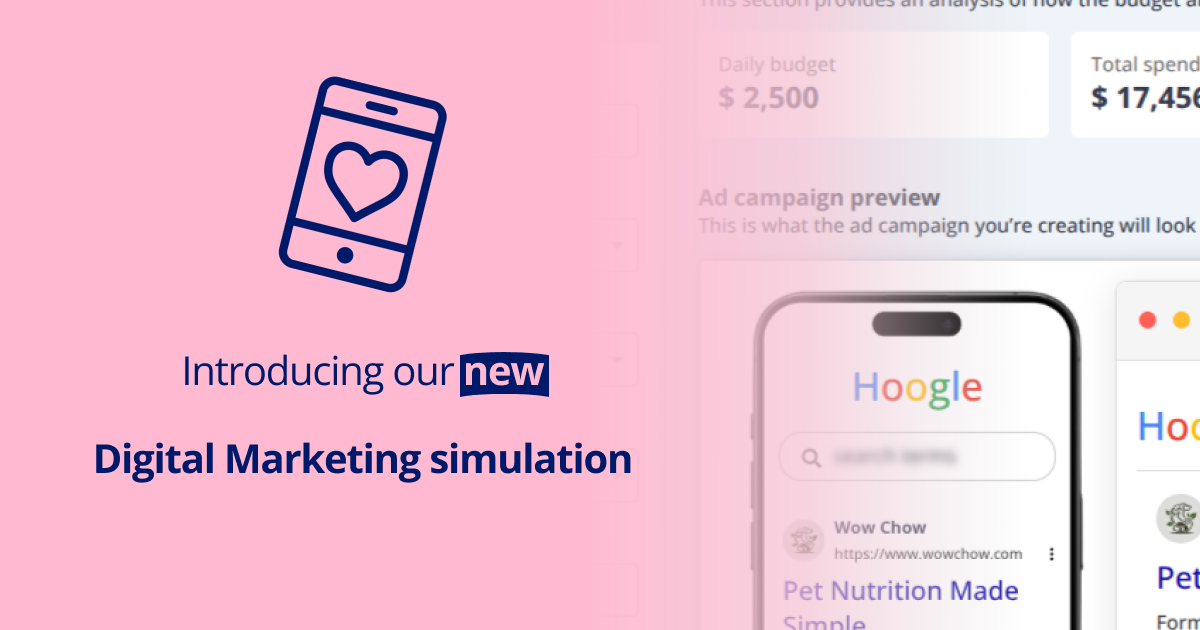
Students are responsible for decisions such as the following:
- Allocating marketing budgets
- Managing social media campaigns
- Optimizing SEO performance
- Improving website conversion
- Analyzing marketing metrics
Because the simulation consolidates marketing activities into one environment, students can focus on learning strategy rather than navigating multiple platforms. Gillis liked that the simulation gave her students a chance to try out different approaches in a safe environment that closely mimics what they’ll be doing in a professional setting:
“I really value real-world application in my courses, and that’s what attracted me to the simulation,” she said. “Students can actually apply what they’re learning instead of just reading about it.”
Explore the new Digital Marketing simulation
Student experience: Learning by doing
Gillis said her students quickly embraced the simulation. Instead of passively learning about marketing concepts, they were actively making strategic decisions and analyzing outcomes.
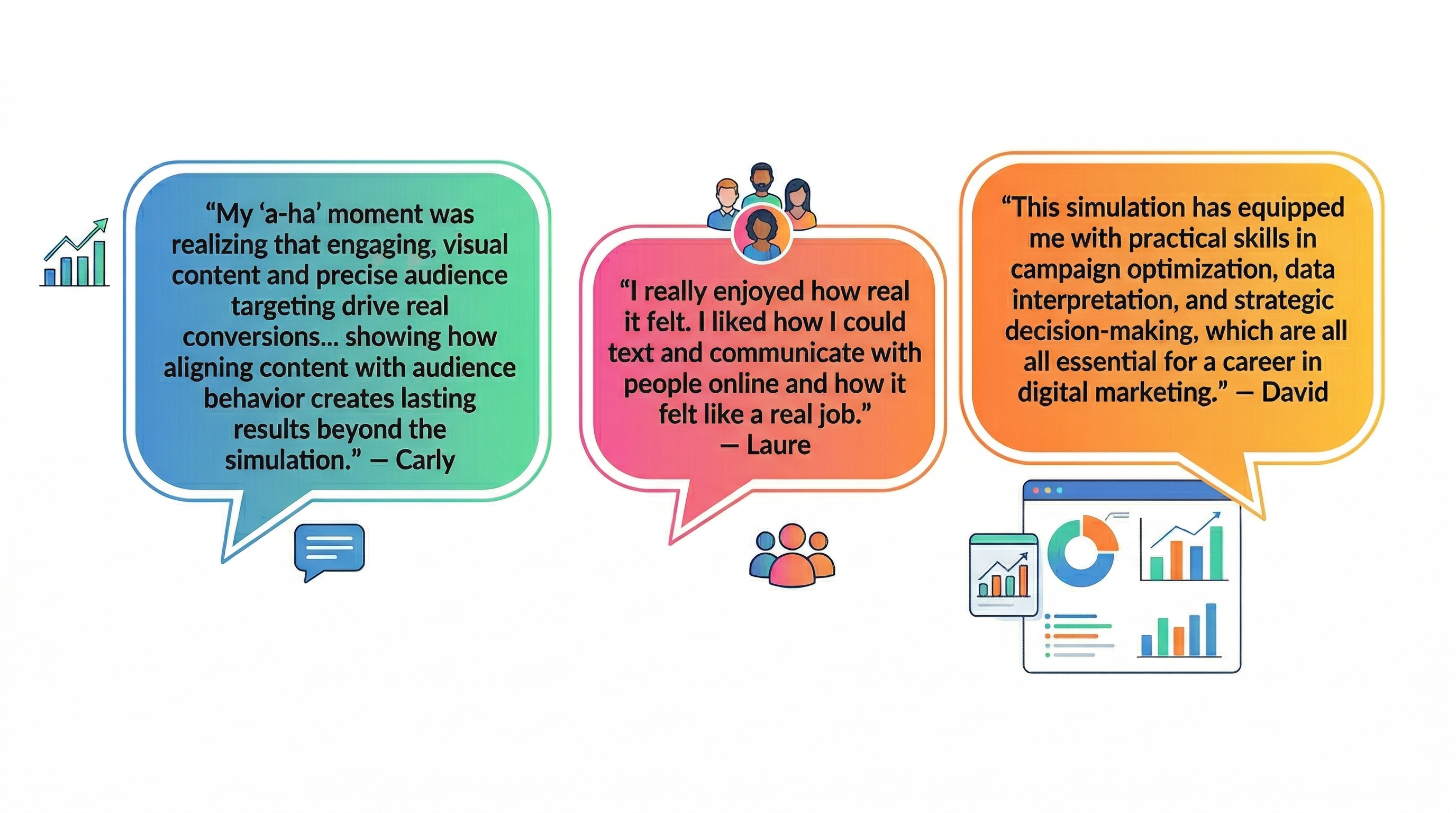
“Students really enjoy the hands-on nature of the simulation, “she said. “They like being able to try different strategies and see what happens.”
Students compared their results with other groups in the class, encouraging them to refine their strategies and improve their performance.
“Students found the simulation both educational and fun, which can sometimes be difficult to achieve,” she added.
Learning outcomes for the digital marketing simulation
By the end of the course, students had developed several important digital marketing skills, including the following:
- Strategic campaign planning
- Data-driven decision-making
- Marketing budget allocation
- Performance analysis
- Understanding the customer journey
Simulations help students experience how marketing strategies evolve based on performance data and market competition. Gillis saw this play out as her students progressed through the simulation.
“In marketing, things don’t always work the way you expect,” she said. “Being able to test strategies and see the results helps students understand the real dynamics of marketing decisions.”
Benefits for instructors
The simulation also delivered benefits from an instructor perspective. As Gillis explained, managing and grading marketing projects for large classes can be time-consuming.
“Grading 60 students in a six-week course is a challenge,” she said. “The simulation helped solve that problem while still giving students a meaningful, real-world project.”
Because the simulation tracks decisions and results automatically, instructors gain visibility into how students are thinking and making strategic choices.
“It’s helpful as an instructor because you can see how students are thinking and what strategies they’re using,” she added.
Why experiential learning matters in marketing education
Experiential learning has become an increasingly important part of business education. Marketing simulations provide a way for students to do several things.
- Practice strategic decision-making
- Experiment in a risk-free environment
- Understand how marketing metrics affect business outcomes
For Gillis, simulations support the type of learning experience she wants to create:
“I always try to bring real-world applications into my courses,” she said. “Tools like this make it possible.”
Results
After integrating the digital marketing simulation, Gillis observed several positive outcomes:
Higher student engagement
Students were more involved because they were actively managing campaigns.
Improved understanding of marketing strategy
Students saw how their decisions influenced results.
Practical experience with marketing analytics
Students learned how to interpret marketing metrics and adjust strategies.
Simplified course management for instructors
The simulation streamlined grading and project management.
Conclusion: Preparing students for modern marketing careers
For Wendy Gillis, the simulation helped transform her Social Media Marketing course from a theoretical experience into a practical one. Students were able to experiment with marketing strategies, analyze performance data and understand the consequences of their decisions.
Most importantly, they gained experience that mirrors the real challenges marketers face every day:
“Students don’t just learn about marketing,” said Gillis. “They experience it.”
Explore Hubro resources
Ready to bring business to life?
Book a demo to see our simulations in action, or get started today and launch with your next cohort.